
A Pedestrian’s Reckoning with a Car-Centric Culture
For decades, traffic engineers have prioritized vehicle safety and efficiency over that of pedestrians. Robert Orr‘s forced transition from driving to walking a decade ago has brought him to a unqiue understanding of the problems that result.
Ten years ago, I experienced what felt like the worst punishment imaginable: my car keys were taken away. Not because of a ticket or illegal activity, but due to a medical condition that made driving unsafe. In a culture built around the automobile, losing access to a car was more than an inconvenience — it felt like exile. I lost not only mobility, but also the independence and freedom I had long taken for granted.
Yet that forced transition — from the speed of driving to the slow rhythm of walking—profoundly changed how I perceive the world.
Over the past decade, I’ve walked everywhere: to stores, appointments, social events, and work. Fortunately, I live in a place where this is at least possible. Though the infrastructure isn’t ideal, it supports a pedestrian lifestyle — most necessities are within walking distance, if often inconveniently so.
Although people are visible almost everywhere in street environments, walking is usually brief: from a parking space as close as possible to an entrance, and back again. Few people travel any real distance on foot. During my longer walks, I’ve noticed that I rarely see the same person twice — evidence of how unusual my way of traveling is.
But walking immerses you in your surroundings in ways driving never can. At a slower pace, the contrast between care and neglect becomes unmistakable.
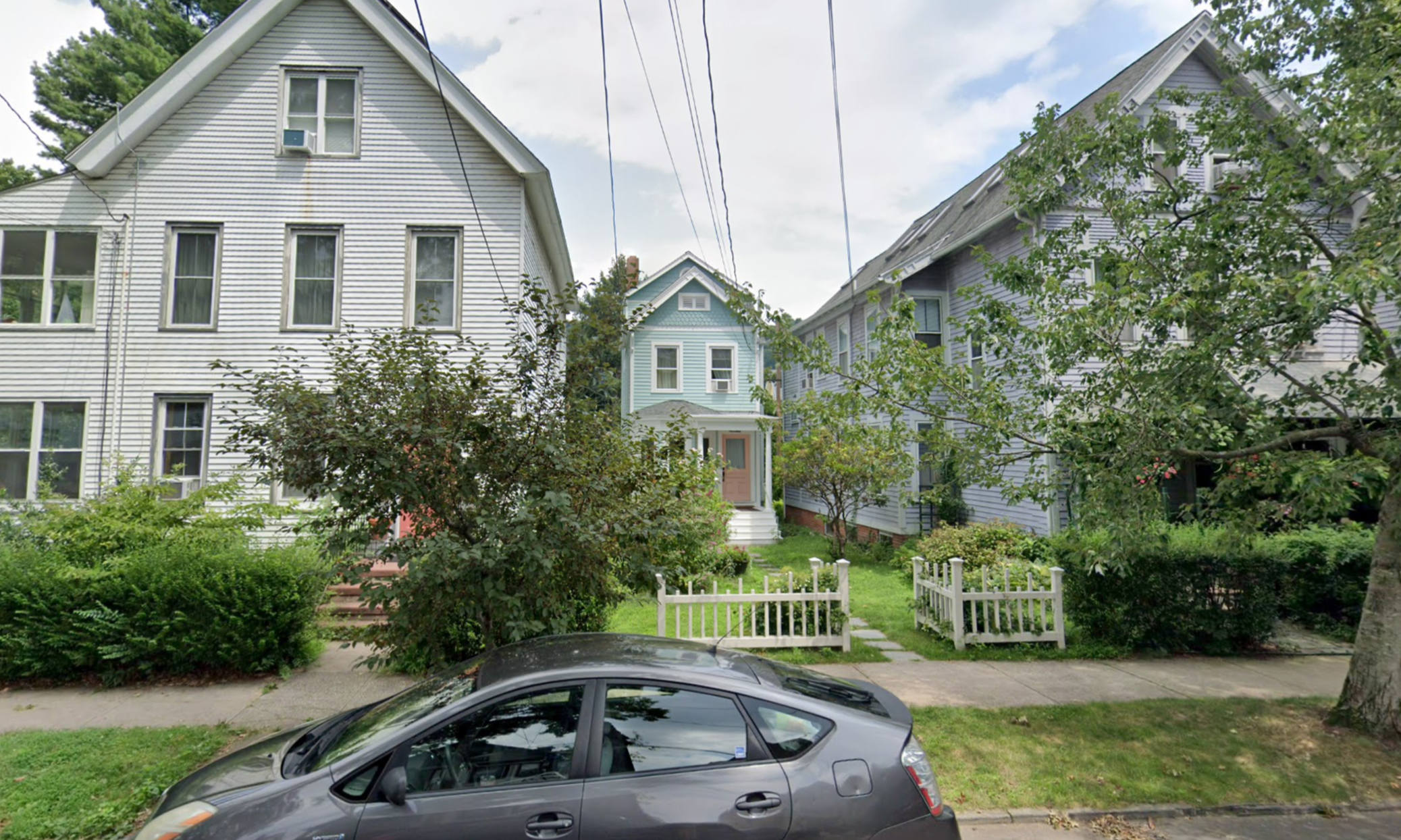
I notice where people lavish attention on their homes; that care communicates pride of place. “Eyes on the street,” in turn, create a sense of pedestrian safety. I also notice hidden surprises—like a tiny house tucked between two others, concealed behind a secret garden (photo, above). These are details invisible to anyone moving through the same street at driving speed.
Walking out of necessity rather than choice also means exposure: to weather, distance, and above all, to the dangers posed by wheeled vehicles. Long walks reveal not just charm, but the hard truth about how our streets are designed — for cars, not people.
I remember several close calls; fortunately, so far, they’ve been limited to being knocked down by a few cyclists. With the rapid rise of e-bikes, scooters, and skateboards, such encounters may become more frequent — and more serious. Even on sidewalks, pedestrians rank lowest in the hierarchy.
This reality runs counter to much of what we hear about “walkability.” From a committed pedestrian’s perspective, many measures promoted as pedestrian safety improvements primarily serve drivers’ comfort and safety instead.
For decades, traffic engineers have been trained almost exclusively to prioritize vehicle safety and efficiency, not pedestrian safety. They often apply the same road design standards to city streets as to highways, including a twelve-foot minimum lane width. Such widths make vehicle operators feel comfortable traveling at higher speeds.
One of the few engineers to challenge the one-size-fits-all practice is Rick Hall, who argues for context sensitive lane widths. In this regard, he argues for maximum lane widths rather than minimums—adjusted downward based on the context of pedestrian proximity. Narrower lanes slow traffic and improve safety for pedestrians, yet they are rarely adopted.
Lane width is a key determinant of design speed — the speed a road implicitly feels comfortable to drive. Higher design speeds, engineers argue, makes drivers feel safer, and accidents occur less frequently, when traveling at slower posted speeds. Ironically, this approach produces the opposite effect: wider lanes encourage drivers to exceed the posted speed, increasing crash risk, severity, and pedestrian fatalities.
The problem becomes acute when there is a large gap between posted speed and design speed. In response to rising pedestrian fatalities, municipalities often take sweeping measures, such as posting municipality-wide lower speed limits. But with design speed urging drivers to break the lower posted speed limits, this strategy is largely ineffective. Asking drivers to travel well below the speed that “feels right” to drive is a fool’s errand.
Originally, streets were designed for pedestrians (including children at play), horse-drawn carriages, and commerce. “Traffic” moved very slowly, at the speed of pedestrians. To modernize older streets under this vehicle-centered framework, cities introduced driving lanes (resorting to one-way traffic where two design speed lanes wouldn’t fit), added turn lanes, and installed roundabouts that eliminate left turns and promote continuous flow. Even something as simple as painting lane lines can increase design speed by as much as nine miles per hour. All of these measures pursue a single objective: move traffic faster to reduce congestion.
The introduction of bike lanes would have seemed a reprehensible intrusion on the single objective, but traffic engineers embraced them. The reason was that, like car lanes, bike lanes are typically wide, straight, and fast — designed according to familiar engineering priorities. Separated from driving lanes, they often increase design speed for cars, as well as for cyclists. The result is not greater harmony, but further isolation of pedestrians amid rising speeds for all vehicle types.
Even features pitched as pedestrian safety improvements—flashing lights, raised crosswalks, curb bump-outs—often function as warnings to pedestrians rather than constraints on drivers, subtly reinforcing whose movement the street prioritizes.
These design choices carry a staggering cost: more than seven thousand pedestrians die while crossing streets, accounting for almost 20% of all traffic fatalities. While one death provokes outrage, seven thousand becomes an abstraction — a statistic that dulls resistance to entrenched design standards.
This mechanized dismissal of pedestrians runs deep. The term “jaywalking” was coined in the early 20th century to shame those deemed uncivilized for crossing mid-block instead of walking to an intersection and back. Yet from a pedestrian’s perspective, mid-block crossings feel safer, offering clearer sightlines and avoiding unpredictable turning movements at intersections.
Faced with hostile arterial streets, many walkers retreat to smaller, secondary streets that have not yet been “improved.” These routes are less direct and slower, but they often feel far safer — even when you’re walking down the middle of them.
Of course, being pushed to fringe routes and navigating dangerous urban cores can be frustrating, sometimes provoking anger. Once, a shirtless cyclist—bristling with six-pack abs — dismounted and challenged me to a fistfight because I didn’t move aside quickly enough on the sidewalk.
That anger fades, however, when one realizes how common roadway hostility has become. AAA and organizations like Zebra and Nextbase report that over 80% of Americans admit to engaging in road rage or aggressive behavior—both inside and outside populated areas.
Our collective anger has many sources: political division, media echo chambers, and economic and ethnic segregation. But one often-overlooked contributor is the erosion of daily, casual human connections in the public realm of streets. As we replaced shared neighborhood spaces with car-dependent “infrastructure,” we lost more than walkability — we lost the humanity that results from routine interactions with people outside our immediate social circle.
This isolation breeds distrust. Without frequent face-to-face encounters — shared space, brief eye contact, small acknowledgments—we lose our capacity to empathize with strangers. The transformation of public streets into highways has stripped them of their role in building social capital. The U.S. Surgeon General now equates social disconnection with the mortality impact of smoking up to fifteen cigarettes a day.
Kurt Braddock, an assistant professor of public communication at American University, warns that polarization and the normalization of violence are becoming deeply embedded in American society. Citing data from Princeton University’s Bridging Divides Initiative, he notes, “We’re moving in a very dangerous direction, and we have been moving that way for quite some time.”
Inside a car, one can pass through blight and despair without sensing danger. But this insulation — this cocooning—also blocks the chance encounters that build relationships and community. Without them, strangers remain strangers, and divisions deepen. Now imagine experiencing that same environment on foot, alone and exposed. The ugliness associated with highway infrastructure, and the nefarious activities it attracts, is positively haunting.
If we want to reduce suspicion, polarization, anger, and violence, we can’t ignore the role of street design. Vehicles need access, but that goal must no longer dominate. Streets must serve a higher purpose: bringing people together.
It’s time to stop designing streets solely as transportation corridors and begin reclaiming them as shared spaces — places centered on people, connection, community, and humanity.
Robert Orr